Alexander Maré
Tracing the Lines of Lost Phenomenology at Kasteelberg: layering counter cartographics and archaeological architectonics to celebrate forgotten Khoekhoen history.
Landscape interpretation centrel
Kasteelberg, Western Cape, ZA
Standing alone amidst rolling wheat fields along the western coast, Kasteelberg is a tall, saddle-shaped hill crowned with boulders and a rich Khoekhoen archaeological record. Despite its history stretching back thousands of years, very few people today know of Kasteelberg’s importance, and most of its archaeological sites remain unexcavated. This project explores what it means to intervene architecturally in a sensitive site without urban design drivers, and how history, archaeology, ritual, and geology can become informants.
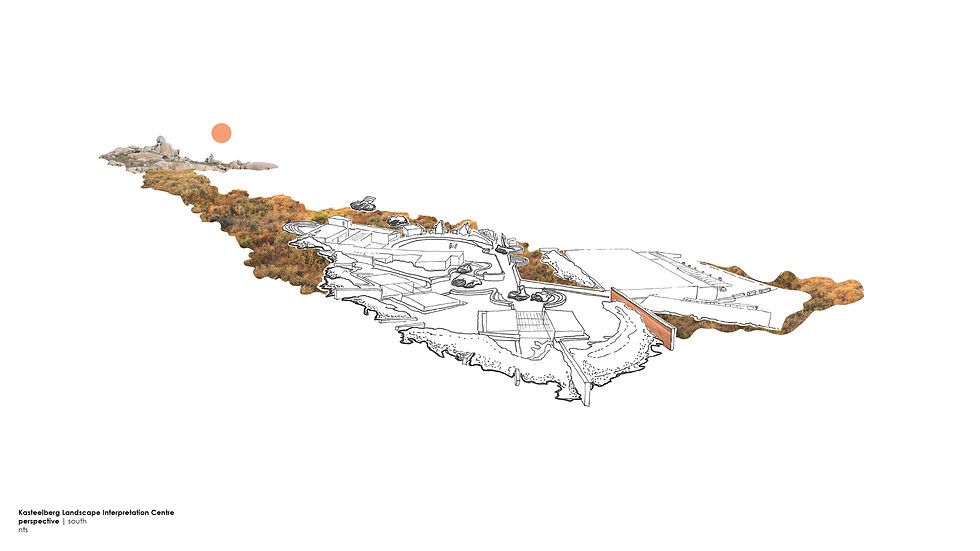
Intervening in the low point of the saddle and mediating between the two sensitive koppies, this project proposes a landscape interpretation centre with both temporary archaeological facilities and more permanent makers spaces drawn from Khoekhoen history. At the intersection of these two seemingly opposed activities is an exhibition space open to visitors, placing sacred and profane in dialogue with each other, and making the spatial argument that traditional forms of place-making and mark-making are also important forms of knowledge production, and that intersections are where meaning emerges.
The siting and program of the intervention derive from a careful reading of the ‘lines of phenomenology’ of Kasteelberg, whether its symmetry, sight lines to distant geographic features, nomadic lines, or the spatial layout of Khoekhoen ritual spaces on the nearby koppies. Informed further by the processes of temporality, geological stratigraphy, and archaeological excavation, the intervention is carved into the site to reveal its stratigraphy and trace routes which become program, some temporary and some permanent, echoing Khoekhoen nomadism and temporary dwellings.
The landscape interpretation centre thus responds to the challenge of intervening in a historical site by proposing a design that is derived from the forms and processes of its historical, ritual, and geological predecessors, proposing an archaeological architectonics.