Tania Rossouw
Bridges of Beliefs: A multi-denominational learning centre & archive to showcase religious diversity in South Africa
Institution/ Education
Country View, Midrand, Gauteng, ZA
This research investigates how architecture can contribute to reconciliation in South Africa by showcasing religious diversity within a shared civic framework. Despite the country’s multicultural faith landscape, historical injustices and spatial fragmentation have limited opportunities for meaningful interfaith encounter. The centralresearch question asks: How can a showcase of religious diversity in South Africa be a form of reconciliation?
The study aims to design a Multi-Denominational Learning Centre and Archive that facilitates interfaith dialogue, education, ritual, and celebration. The objectives include documenting South Africa’s religious history, creating inclusive spaces for worship and community events, and testing architectural strategies that balance neutrality with celebrating difference. At its core, the project seeks to use architecture to showcase respect, cultural visibility, and shared belonging.
The methodology combinedcase and site studies with iterative design development. Case studies such as the Salk Institute, the Abrahamic Family House, and the Bahá’í House of Worship informed the exploration of neutrality, inclusivity, and symbolic expression. Environmental analysis of the Midrand site shaped strategies around orientation, water, landscape integration, and ecological sensitivity. Conceptual iterations were used to test spatial narratives of unity, diversity, and reconciliation.
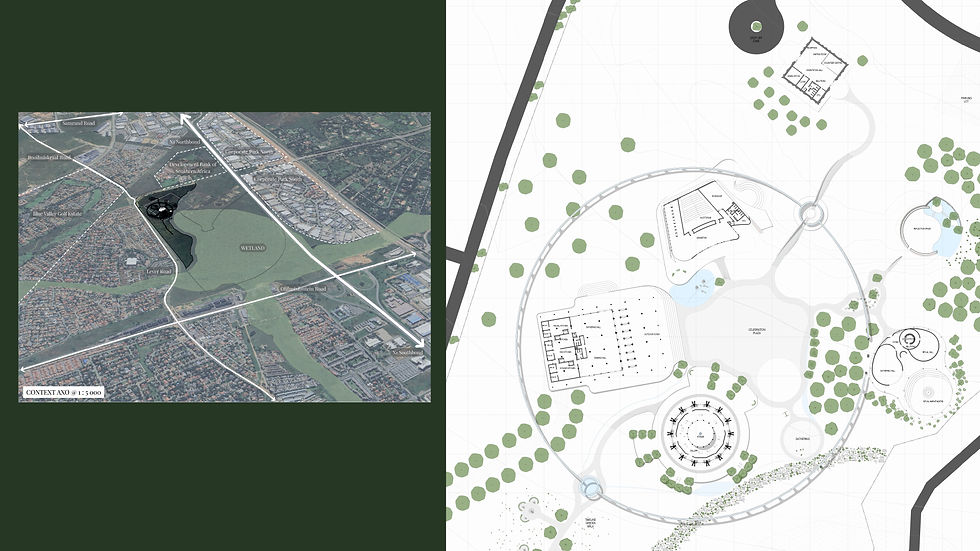
The proposed intervention is located in Country View, Midrand. The programme includes a gallery of artefacts, an interfaith archive library,dialogue halls, worshipand reflection rooms, celebration plazas, and outdoor ritual landscapes integrated with the site’s wetland. The design employs courtyards, processional routes,and a balance of communaland private spaces to create neutral ground and spaces of distinct expression.
This demonstrates that architecture can be more than a framework of faith; it can be a mediator of difference and a catalyst for reconciliation. By foregrounding inclusivity, neutrality, and ecological ethics, the project offers a model for future interfaith architecture in South Africa’s pursuit of unity in diversity.